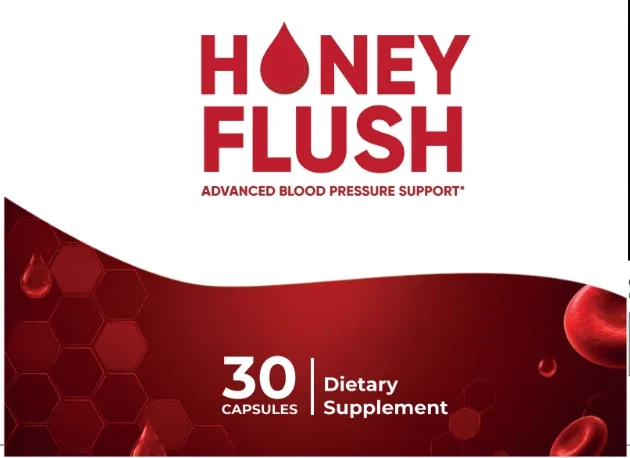
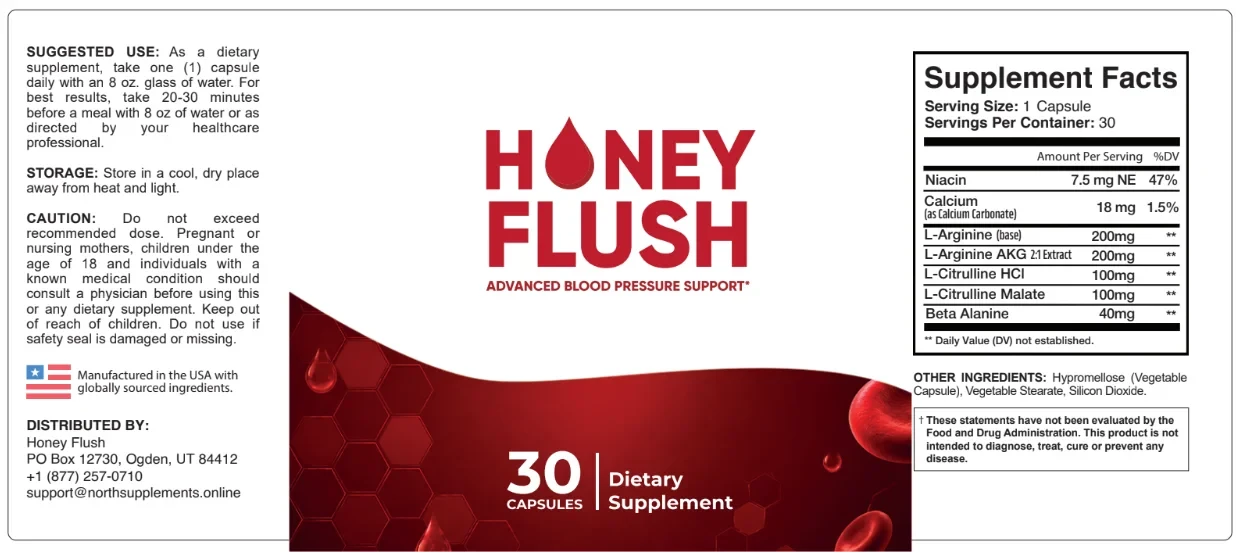
Honey Flush's Supplement Facts panel lists seven ingredient lines in one vegetable capsule, each with its amount. This page transcribes the panel, explains each ingredient with the NIH research behind it, and shows the full label.

Editorial disclosure: tryhoneyflush.com is an independent guide and is not the manufacturer or distributor of Honey Flush. It contains affiliate links, and we may earn a commission if you purchase through them, at no extra cost to you. These statements have not been evaluated by the Food and Drug Administration. Honey Flush is not intended to diagnose, treat, cure, or prevent any disease. Consult a healthcare professional before use.
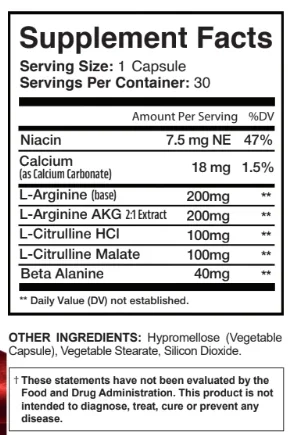
One capsule is one serving, and each ingredient has its own milligram figure. Here is the Supplement Facts box typed out exactly as it appears on the bottle, with the directions and warning printed next to it.
| Serving size | 1 capsule |
|---|---|
| Servings per container | 30 |
| Niacin | 7.5 mg NE (47% Daily Value) |
| Calcium (as calcium carbonate) | 18 mg (1.5% Daily Value) |
| L-arginine (base) | 200 mg |
| L-arginine AKG 2:1 extract | 200 mg |
| L-citrulline HCl | 100 mg |
| L-citrulline malate | 100 mg |
| Beta-alanine | 40 mg |
| Other ingredients | Hypromellose (vegetable capsule), vegetable stearate, silicon dioxide |
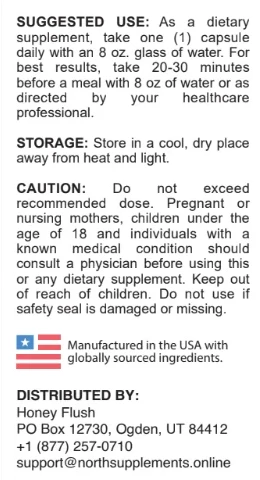
| Suggested use | One capsule daily with an 8 oz glass of water; for best results 20–30 minutes before a meal, or as directed by a healthcare professional |
| Storage | Cool, dry place, away from heat and light |
| Caution | Do not exceed the recommended dose; pregnant or nursing mothers, children under 18 and individuals with a known medical condition should consult a physician first; keep out of reach of children; do not use if the safety seal is damaged or missing |
| Distributed by | Honey Flush, PO Box 12730, Ogden, UT 84412 · +1 (877) 257-0710 · support@northsupplements.online |
| Origin | Manufactured in the USA with globally sourced ingredients (label wording) |
Each note draws on an NIH Office of Dietary Supplements fact sheet. Those sheets describe the nutrients in general. None of them studied Honey Flush.
Arginine is an amino acid found in protein foods, especially animal products and nuts; a typical diet supplies 4–5 g a day. The ODS fact sheet notes that some arginine is converted into nitric oxide, which widens blood vessels and can increase blood flow to muscle. "Base" means the plain amino acid, not a salt.
NIH ODS fact sheetArginine alpha-ketoglutarate, a compound of arginine with alpha-ketoglutarate, a natural molecule of energy metabolism. "2:1" describes two parts arginine to one part AKG. With the base form, the capsule carries 400 mg of arginine compounds. See the L-arginine guide.
NIH ODS fact sheetCitrulline is a nonessential amino acid, made in the body and found in watermelon (about 365 mg in a cup). The ODS fact sheet notes that about 80% of the body's citrulline is converted into arginine in the kidneys. HCl is the hydrochloride form.
NIH ODS fact sheetCitrulline bound to malic acid, the form used in most citrulline studies. By weight it is about 57% citrulline, so 100 mg supplies roughly 57 mg of citrulline. See the L-citrulline guide.
NIH ODS fact sheetVitamin B3. "NE" (niacin equivalents) counts niacin and the niacin the body makes from tryptophan. The ODS Daily Value is 16 mg, so one capsule supplies 47%; the adult upper limit for supplemental niacin is 35 mg a day. The label does not say which form is used. See the niacin guide.
NIH ODS niacin fact sheetCalcium from calcium carbonate at 1.5% of the 1,300 mg Daily Value. Beta-alanine is an amino acid the body uses to build carnosine in muscle; exercise studies used grams a day, so 40 mg is a small amount.
NIH ODS calcium · NIH ODS exerciseThe capsule shell, a plant-cellulose material used instead of gelatin. The label calls it a vegetable capsule.
A plant-derived flow agent that helps the powder fill each capsule evenly. It is used in very small amounts.
A common anti-caking agent that keeps the powder from clumping. Also used in many foods.
No honey, caffeine, sugar or stimulant is listed. The label does not name gluten, dairy or soy ingredients, and it makes no vegan or allergen claim of its own.
Per capsule: niacin 7.5 mg NE, calcium 18 mg (as calcium carbonate), L-arginine base 200 mg, L-arginine AKG 2:1 200 mg, L-citrulline HCl 100 mg, L-citrulline malate 100 mg and beta-alanine 40 mg. Other ingredients: hypromellose (vegetable capsule), vegetable stearate and silicon dioxide.
No. Honey is not on the label. The name is a brand name.
400 mg of arginine compounds per capsule: 200 mg of arginine base and 200 mg of arginine AKG.
200 mg per capsule: 100 mg of citrulline HCl and 100 mg of citrulline malate.
Alpha-ketoglutarate. Arginine AKG 2:1 is a compound of two parts arginine to one part alpha-ketoglutarate.
Niacin equivalents: the unit for niacin, where 1 mg NE equals 1 mg of niacin or 60 mg of the amino acid tryptophan, as the NIH niacin fact sheet explains.
No caffeine or other stimulant is listed on the label.
No. Each ingredient has its own amount on the Supplement Facts panel.
The capsule is hypromellose, a plant-cellulose material the label calls a vegetable capsule, and no animal ingredient is named. The label makes no formal vegetarian or vegan claim.
No. Nitric oxide is a gas the body makes; arginine and citrulline are the two amino acids most often discussed as its building blocks, which is why many supplements, Honey Flush included, list them.
Pick 2, 3 or 6 bottles on gethoneyflush.com. Three or more ship free in the US, and every order comes with a 180-day refund promise. Not sure how to order? Our buying guide walks you through it.
Visit gethoneyflush.com