L-citrulline is the amino acid the body turns into arginine, and the partner arginine is most often sold with. This guide explains what it is, the forms on labels, the doses studied and what the NIH says about its safety, with Honey Flush as an example.

Editorial disclosure: tryhoneyflush.com is an independent guide and is not the manufacturer or distributor of Honey Flush. It contains affiliate links, and we may earn a commission if you purchase through them, at no extra cost to you. These statements have not been evaluated by the Food and Drug Administration. Honey Flush is not intended to diagnose, treat, cure, or prevent any disease. Consult a healthcare professional before use.
L-citrulline is a nonessential amino acid: the body makes it, mainly from glutamine, and it also comes from food. Its best-known source is watermelon, whose Latin name, Citrullus, gave it its name; a cup of diced seedless watermelon holds about 365 mg. Unlike arginine, citrulline is not used to build proteins. Its main job is as a step toward arginine and, from there, nitric oxide.
NIH ODS fact sheetThe NIH fact sheet notes that about 80% of the body's citrulline is converted into arginine in the kidneys. Arginine is then partly turned into nitric oxide. Formulas that pair the two, such as Honey Flush, supply both the end amino acid and its source.
Made in the body and found in watermelon.
About 80% of citrulline becomes arginine in the kidneys.
Part of the arginine becomes nitric oxide in the lining of blood vessels.
| Form on the label | What it is | In Honey Flush |
|---|---|---|
| L-citrulline | The plain amino acid | Not listed alone |
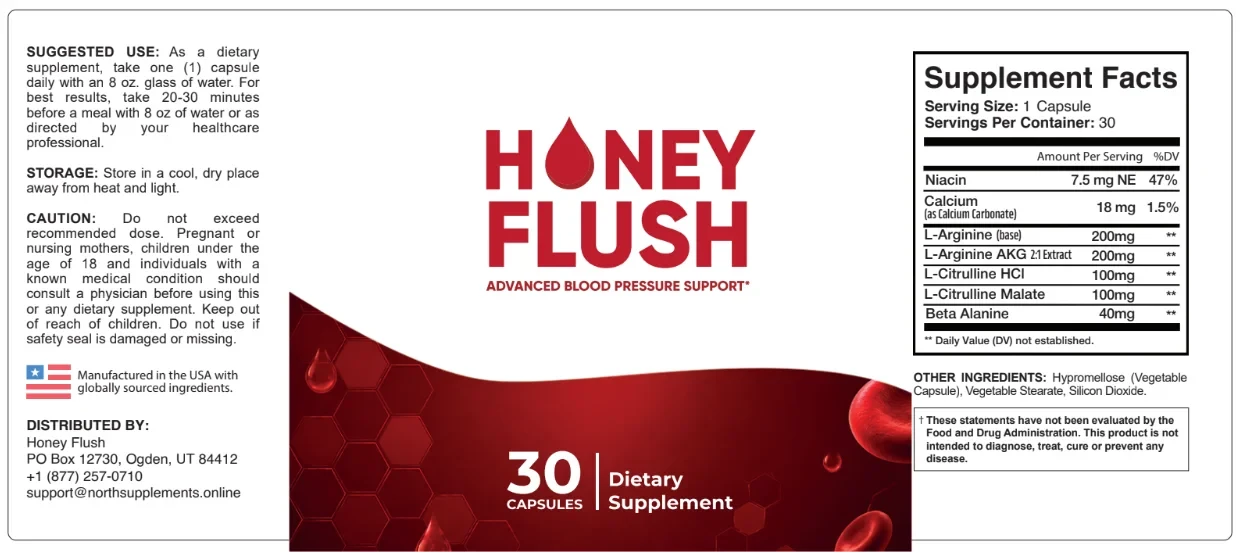
| L-citrulline malate | Citrulline bound to malic acid; about 57% citrulline by weight; the form used in most studies | 100 mg |
| L-citrulline HCl | Citrulline as a hydrochloride salt | 100 mg |
The NIH fact sheet puts citrulline malate at 56.64% citrulline, so 1 g supplies about 566 mg of citrulline.
In one study, 8 g of citrulline malate an hour before bench presses improved repetitions in 41 weightlifters; in another, 3 g of plain citrulline before testing, or 9 g over 24 hours, did not improve treadmill performance. Results depend on the form and the test, so the evidence so far is mixed.
Nonathletes took up to 6 g a day for 4 weeks, or 1.35 g a day for 6 weeks, with no adverse effects reported. Long-term safety has not been fully assessed, and a few people in the weightlifting study reported stomach discomfort. Anyone who takes prescription medication should check with a doctor first.
Honey Flush lists 100 mg of L-citrulline HCl and 100 mg of L-citrulline malate per capsule, alongside 400 mg of arginine compounds, niacin, calcium and beta-alanine. As with arginine, the amounts are modest next to the gram doses studied; the capsule is built for a steady daily routine. The full panel is on the Honey Flush ingredients page.
A nonessential amino acid that the body makes and that watermelon supplies. Most of it is converted into arginine in the kidneys.
It serves as a source of arginine, which the body partly turns into nitric oxide. That is why it appears in nitric oxide supplements.
They are a pair rather than rivals: the body makes arginine from citrulline. Many formulas, Honey Flush included, list both.
Citrulline bound to malic acid, about 57% citrulline by weight. It is the form used in most citrulline studies.
About 365 mg in one cup of diced seedless watermelon, according to the NIH fact sheet.
Up to 6 g a day for 4 weeks was reported without adverse effects in nonathletes; long-term safety has not been fully assessed. Check with a doctor first if you take medication.
Many supplements combine them because citrulline becomes arginine in the body. Stay at the label serving of any combined product.
200 mg per capsule: 100 mg of L-citrulline HCl and 100 mg of L-citrulline malate.
Honey Flush lists two forms of L-citrulline with L-arginine base and AKG, every amount printed, and a 180-day guarantee on direct orders. See the full label first.
Visit gethoneyflush.com